The Consumer Credit Directive (CCD2) will take effect throughout the EU on November 20, 2026, and establishes new rules regarding when an installment payment is legally considered a consumer credit and what obligations the contracting party, as the “lender,” will then have.
This applies to sales to individual customers residing in the EU where the provision of goods or services and payment occur at different times, and payment is made only after the goods or services have been provided.
At a Glance
- The CCD2 will take effect on November 20, 2026, with no transition period.
- It applies to installment payments to individual customers in the EU when the service is provided before payment is made, even if the payment is interest-free and even for small amounts.
- The special status previously granted to "Buy Now, Pay Later," 0% financing, and small-amount loans no longer applies: These are now covered by the Consumer Credit Directive.
- Subscriptions, memberships, advance payments, and purchase on account with a short payment term will continue to be available.
Let's start with the good news: Most payment models in online business will remain the same. For the rest, there are alternatives that still allow your customers to pay flexibly while also optimizing your cash flow and protecting you against payment defaults.
This article provides information on the key provisions of the Consumer Credit Directive so that you can review and adjust your offers. We at the ablefy team review all information with our compliance team; however, this article is not a substitute for legal advice.
This article will be updated to reflect changes resulting from court decisions and interpretations. The current version is as of October 16, 2026.
ablefy will regularly publish webinars and articles on this topic that show you specific examples of how to put these ideas into practice. If you don't want to miss anything, feel free to sign up for our newsletter.
In this article, you'll learn what the Consumer Credit Directive is, which offers are affected, and how to plan your launches safely starting in November.
What is the Consumer Credit Directive (CCD2)?
CCD2 stands for Consumer Credit Directive 2. It replaces the previous EU Consumer Credit Directive of 2008. Germany has implemented it through an umbrella law*, which will take effect on November 20, 2026.
The logic behind this is simple: Anyone who receives the full amount up front and pays later in installments is, legally speaking, taking out a loan. Whether interest is charged on this loan is irrelevant.
The goal is consumer protection: Individual customers should be just as protected under “Buy Now, Pay Later” arrangements as they are with a traditional bank loan. Until now, many installment plans have fallen outside the scope of consumer credit law due to exceptions, and it is precisely these gaps that the CCD2 closes.
The goal is to better protect consumers from excessive debt. Ultimately, this also protects you in many cases from unexpected payment defaults, because customers’ creditworthiness must be checked and documented before a purchase is made.
What does this change mean for coaches and creators?
Online entrepreneurs must also adapt their offerings.
If you sell a high-priced program, you know that installment payments are a conversion lever: A course costing €2,000 becomes affordable for many people when paid in 10 installments of €200, and installment payments noticeably lower the barrier to purchase.
It is precisely this model that is at the heart of the change. If your participants receive a service before they have paid in full, as of November 20, 2026, this will legally constitute a loan, without the previous exceptions.
That doesn't mean you have to give up flexible payment options. It means you need to structure your offer a little differently so that it continues to work and remains legally sound.
When does the Consumer Credit Directive apply, and when does it not?
- B2C transactions with customers in the EU: The directive applies in full in these cases.
- B2B customers: You don't qualify. It's important that you provide verifiable proof of your business status. Simply self-identifying as a business during checkout is not enough.
- Customers outside the EU: This does not apply to you. What matters is where the end customers are located, not where you, as the provider, are located.
What is covered by the Consumer Credit Directive?
Installment payments after full service has been rendered, including interest-free options and amounts under €200, as well as “Buy Now, Pay Later” offers such as those from PayPal or Klarna. This does not mean that BNPL is eliminated: The obligations associated with a consumer loan are assumed here by the licensed payment partner.
What is not included?
- Ongoing Benefits with Regular Payments
- Advance Payments Before Services Are Rendered
- Purchase on account with a short payment term
- Installment payments for business customers (provided you can verify your business status)
What about contracts that have already been signed?
The existing law applies to these contracts. This means you do not need to adjust any ongoing installment payments. The new rules take effect for contracts entered into on or after November 20, 2026.
What happens in the event of violations of the Consumer Credit Directive?
- Fines of up to €500,000 for operating as a lender without registration under the Financing Business Act (AfFinAG)
- Fines of up to €50,000 for violations of the Trade Regulations
- An extended right of withdrawal of up to one year and 14 days if precontractual obligations are not fulfilled
- Warning letters from competitors and trade associations, for example, due to missing mandatory information in advertisements
What alternatives are there to paying in installments?
Payment Model
Example
Classification
Recurring Benefits with Corresponding Payments
Membership, Subscription, Coaching with Monthly Payments
No credit required; fixed terms of up to 24 months available
Down Payment
Event Tickets Payable in Installments Until the Event
No credit
Purchase on account
Lump-sum payment with payment terms
No credit for payment terms of up to 14 days; up to 50 days for SMEs
Payment Only After Services Are Rendered
8 weeks of coaching, but pay for 8 months
This is considered a consumer loan and is offered securely through ablefy's BNPL partners
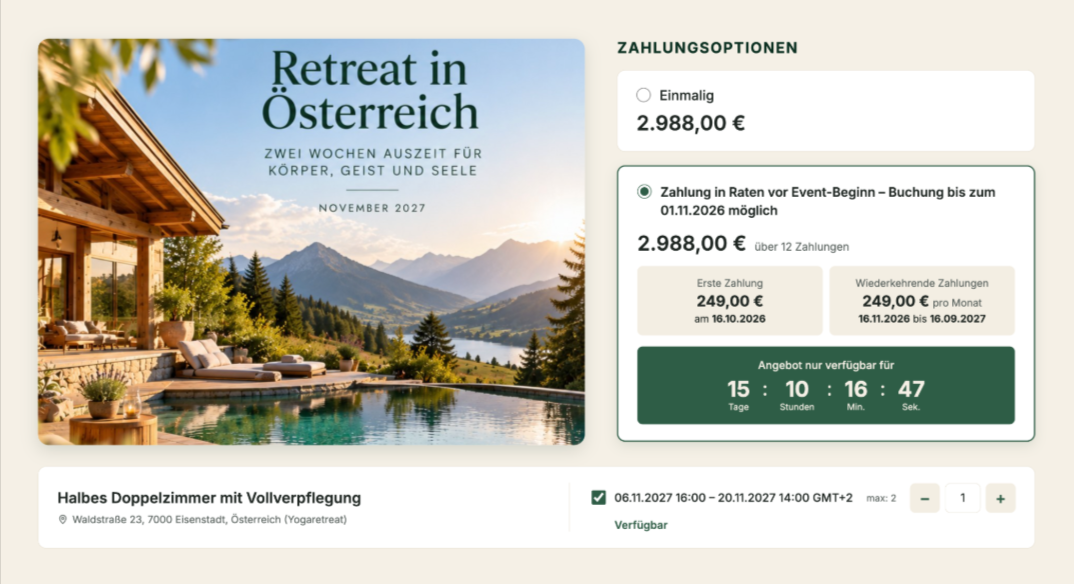
Example: Down Payment
The event will take place in November 2027. Individual customers can pay for it in installments, with the entire amount due before the event takes place—that is, before the service is provided.
Buy Now, Pay Later through a licensed partner
Providers such as Klarna may continue to be offered at checkout—for example, through ablefy—because these providers meet the requirements for lenders. This means your customers can continue to pay in installments through Klarna. Here’s what you need to keep in mind:
- As a merchant, you'll incur additional transaction fees for payments made through Klarna and similar services.
- Customers may be declined by Klarna.
- Klarna handles all collections and reminders, and you have already received the full amount.
Subscriptions, Memberships, and Ongoing Programs
Monthly payments for ongoing access to your content or for ongoing coaching programs with payments made at regular intervals do not constitute a loan. This applies, for example, to your membership or community, a SaaS service, or group coaching, where the service is provided month after month. In these cases, the service and payment occur simultaneously. There are three points you should keep in mind:
- Fixed contract terms (such as minimum terms for subscriptions) are only permitted for B2C customers for up to 24 months.
- According to this provision, an automatic renewal may continue only if it can be canceled on a monthly basis.
- Access must end when the contract expires.
Deposit and Advance Payment
If your customers pay before you provide the service, that’s an interest-free prepayment. Example: Your participants pay the installments for your live program before the course starts, and the program doesn’t begin until after that. In this case, you’re not extending credit—you’re being paid in advance.
Important: Anyone who has not paid in full by the start date will not be granted access. Therefore, it must be possible to block access.
Purchase on account with a short payment term
A one-time payment by invoice is not subject to CCD2 if all of the following conditions are met:
- You set the payment terms yourself, without a financing partner such as BNPL.
- There is no charge for the service; fees are only incurred in the event of a delay.
- The deadline is short enough: a maximum of 50 days if you're an SME* selling under your own name, and a maximum of 14 days if you're not an SME or if you're selling through ablefy under the reseller model.
Can I even offer traditional installment plans anymore?
If you want to offer a traditional deferred payment plan—where your clients receive the service first and pay later—you are legally considered a lender. This means you have basic obligations similar to those of a bank.
Ablefy strongly advises coaches and creators against this, as these requirements are nearly impossible for solo entrepreneurs or small businesses to meet on their own:
- Credit check before every contract. Before granting a loan, the customer’s ability to pay must be verified and thoroughly documented. This includes information and proof of income and expenses, a credit score, and a documented decision. This applies even to a course costing €89 paid in installments.
- Pre-contractual Information (SECCI). Before finalizing the purchase, your customers must receive the European Standard Information on Consumer Credit, or SECCI for short. They will later confirm that they have received the documents. Because there is usually less than a day between receiving the information and making the purchase during the checkout process, a reminder of the right of withdrawal after the purchase is also necessary.
- Registration or License. Anyone who grants credit on their own must register with BaFin in the future. This requirement is based on the new Sales Financing Supervision Act (AbsFinAG). Anyone who acts as an intermediary for a partner’s BNPL service must, depending on the model, obtain a license as a loan broker under Section 34k of the German Trade Regulation Act (Gewerbeordnung), including proof of professional competence.
- Advertising with clear information. Anyone advertising installment plans must clearly state the costs and include a warning notice. Advertising that suggests a loan will improve a person’s financial situation is prohibited.
What are SMEs, and what special provisions apply to them?
SME stands for small and medium-sized enterprises. According to EU Recommendation 2003/361/EC, the following thresholds apply:
- Number of employees: fewer than 250. This criterion must always be met.
- Annual revenue: less than 50 million euros
- Total assets: less than 43 million euros
Affiliated Companies and Group Structures: If another company holds more than 25% (partner company) or more than 50% (affiliate) of the shares, its employee and financial figures must be included on a pro rata basis or in full, respectively.
What does this mean for ablefy users?
If you sell under your own name, you can take advantage of the SME regulations, provided they apply to you. This should be the case for most sellers who sell under their own name.
If you sell through a reseller model, the SME exemptions do not apply, since the reseller is not an SME.
Relief Measures for SMEs
Regulation
SMEs
Non-SMEs
Basis
Purchase on Account / Deferred Payment Without Credit
Up to 50 days
Up to 14 days for online or distance sales. In addition, no third party may acquire the receivable, for example through factoring.
Art. 2, para. 2, subpar. h of CCD2; § 506, para. 1, sentence 2, no. 5 of the BGB
BaFin Registration as a Lender
Not applicable if the deferral is provided free of charge and is granted solely as an ancillary benefit to the company's own product
Requirement
§ 4 of the FinAG
License as a credit broker (e.g., with Klarna in your own checkout)
The exception for “mediation in a subordinate capacity” applies
This exception no longer applies following the reform
§ 34k of the Trade Regulation Act (GewO)
What does this mean for the market?
Credit obligations are being handled by specialized providers, so you, as a creator, can focus on your content.
If you’ve mainly sold high-priced products via BNPL (such as through PayPal or Klarna), you can continue to do so because the payment partner assumes the credit obligations. However, keep in mind that the pre-purchase credit check for large amounts can more frequently lead to rejections or abandoned purchases. It’s worth having an alternative ready as a fallback option.
The article“Selling Online Courses in Compliance with the Law: The Practical Handbook for Providers 2026” shows you how to set up your sales in a legally compliant manner.
Frequently Asked Questions About the Consumer Credit Directive (CCD2)
When does the Consumer Credit Directive take effect?
The CCD2 will take effect throughout the EU on November 20, 2026, with no transition period. Contracts entered into before that date will continue to be governed by the previous law.
*Does the EU Consumer Credit Directive apply to Germany?
Yes. CCD2 is the Consumer Credit Directive 2 of the European Parliament and of the Council, officially Directive (EU) 2023/2225. It replaces the previous EU Consumer Credit Directive from 2008. Germany has implemented it through an umbrella law dated May 12, 2026, which will take effect on November 20, 2026. As part of this process, there are changes to provisions in the German Civil Code (BGB), the German Banking Act (KWG), the Trade Regulation Act (GweO), and the Introductory Act to the BGB (BGBEG), as well as new provisions for the Sales Financing Supervision Act (AbsFinAG).
Can I continue to offer payment in installments?
Only if you meet strict requirements, which is virtually impossible for small and medium-sized businesses. If your customers receive the service before they have paid in full, you are legally granting a loan and are considered a lender. As such, you must check and document their creditworthiness before every purchase, provide your customers with a standardized credit information sheet (SECCI), and correctly inform them of their right of withdrawal. Alternatively, you can use a third-party provider like ablefy to offer legally compliant solutions.
Does the directive also apply to amounts under 200 euros?
Yes. The previous exception for small amounts no longer applies. What matters is not the amount, but whether the service is provided before payment is made.
Does this regulation apply to me if I only sell to businesses?
No, purely B2B transactions are excluded. However, you must be able to verify your customers' business status. If you use ablefy, our system handles this verification by validating their VAT ID number.
FAQ Collection in the ablefy Help Section
In our Help section, you'll find our FAQ collection with examples of how to set up your ablefy listings.
Stay up to date
We will gradually be releasing more information on this topic and offering live Q&A sessions for our customers.
Are you already a provider with us and have specific questions about adjusting your payment plans? If so, please feel free to contact your Customer Success Manager or our customer support team.
Please note that we are not permitted to provide legal advice on this matter.